Thursday, December 18, 2025

How Religious Freedom in America Was Founded on Privatization and Decentralization

 A common myth about American history is the one in which a handful of so-called “founding fathers” in the 1780s declared that America would create a “wall of separation” between religious institutions and government institutions. After that, the First Amendment to the US constitution was instrumental in ensuring that religious institutions would be totally separate from American political institutions. Or so the story goes.

Much of this myth is premised on the idea that the spread of religious freedom in America was a top-down process. In this narrative, the process was guided by non-Christian secularists like Thomas Jefferson who were especially influenced by the ideology of the French Enlightenment. 

This historical narrative is wrong in nearly every way. For example, it is not at all the case that the First Amendment was central to the process of disestablishment—the process of abolishing the “official” churches who held favored positions within most state governments. Rather, this process was carried out overwhelmingly in the state legislatures—and some of this was done before the First Amendment was even written. Nor is it true that the process of disestablishment was guided primarily by the thinking of the so-called “Enlightenment.” Rather, it was mostly Christian activists who sought to end disestablishment as a means of clearing the way for the non-established Christian groups who had not benefited from taxpayer funding or regulatory favoritism. Disestablishment was, in other words, a means of privatizing the churches and creating a “free market” in religious practice. Most who favored disestablishment thought it would lead to the spread of religious practice, not its abolition or restriction. 

It was not until the twentieth century, when most American jurists and policymakers had thoroughly adopted truly secularist views, that the First Amendment came to be seen as a legal tool to dictate to state and local governments how they ought to regulate the relationship between church and state. 

Disestablishment: A State-Level Process 

Popular narratives have long focused almost exclusively on the federal government in the realm of religious freedom, and this has usually obscured the decentralized reality of disestablishment. As Michael Baysa puts it: ”The disestablishment of religion in America has a long and storied history that, at times, becomes muddled with the histories of the first amendment of the United States Constitution; Thomas Jefferson’s famous language of the “separation of church and state”; anti-Anglicanism during the Revolutionary War; and court cases over the freedom of religious exercise.”[1]

When we’re talking about the spread of religious freedom during the late eighteenth and the nineteenth century, the story is overwhelmingly one that plays out at the state level. 

After all, there never was any established national Church in America at all. Consequently, there is no process of disestablishment at the federal level to describe. Rather, the First Amendment was largely the product of anti-federalists and other decentralists who wanted guarantees that the federal government would not intervene at all in state laws related to religion. This is why the First Amendment states that  “Congress shall make no law respecting an establishment of religion, or prohibiting the free exercise thereof.” It is only the national legislature, Congress, that is limited by this text. This established that policy related to the churches was to be exercised outside the purview of the federal government.

In this context, it made perfect sense when President Andrew Jackson refused to issue a national proclamation of prayer and thanksgiving—as some presidents before him had—insisting that a federal proclamation “might disturb the security which religion now enjoys in the country, in its complete separation from the political concerns of the General Government.” Again, note the concern here is a connection between religion and the “general” (i.e., federal) government.[2] There was no question as to whether or not state governments could issue such proclamations. It was widely accepted that they could. 

Moreover, many of the states had already begun the process of disestablishment before the Bill of Rights was even ratified in 1791. New York and North Carolina disestablished in the 1770s, and Virginia did so in the 1780s. South Carolina followed in 1790. Indeed, by the time Andrew Jackson was sworn in in 1829, only Massachusetts retained an established church. That ended in 1833. 

The process overturned what had been a well established colonial practice of establishment churches. Prior to the American revolution, 

In America, government churches provided services in all but three of the 13 colonies. In New York, New Jersey, Maryland, and the southern colonies, the established church was Anglican. This church was disestablished after the Revolution. Within New England, excepting Rhode Island, the established churches were Congregational.[3]

The disestablishment process that took place from the 1770s to the 1830s was all done without any mandate or oversight from the federal government under the auspices of the First Amendment.  This process is described in detail in a 2019 book, Disestablishment and Religious Dissent: Church-State Relations in the New American States, 17761833, edited by Carl H. Esbeck and Jonathan J. Den Hartog.

The editors first note that the process was very diverse in nature, stating “Each colony had unique and differing traditions of church-state relations rooted in the colony’s peoples, their countries of origin, church affiliations, and theological principles.”[4]

The issue of secularization or disestablishment at the federal level was simply not a pressing issue. Esback and Den Hartog continue: 

There was never a national disestablishment. Neither the federal government, instituted in 1789 in New York City, nor the Articles of Confederation, approved in 1781 near the end of the revolutionary fighting, ever had anything resembling an established church. So there was nothing to dismantle. Rather disestablishment was entirely a state-by-state affair.[5]

One would certainly not know this from the usual sloganeering and popular history frequently employed in the context of religious freedom. Contrary to the usual narrative, there is no federal history of disestablishment that has been, as Esbeck and Den Hartog put it, “repeated as axioms in grade-school social studies classroom right on through textbooks for university undergraduates.”[6]

Disestablishment took many forms and the way it was carried out varied from state to state. Perhaps the most important factor in disestablishment was ending taxpayer-funded financial support for the state church. These funds were used to pay salaries for church personnel and to pay rents. State laws favoring established churches also were used to regulate religious creeds, clerical appointments, and the keeping of legal records on matters such as marriages and deaths. Established churches generally enjoyed a pride of place in controlling legal records and managing tax-funded poverty relief programs. 

In some cases, state government even mandated attendance of worship services of the established church. This could be enforced by fines or other sanctions as had been the case in England when so-called “dissenters” were sanctioned for being absent at official church services. 

Often, the laws establishing and protecting the state church were not all repealed at once, but gradually over a period. Some remnants of these laws lingered until the mid-twentieth century, but by the 1830s, disestablishment was clearly the dominant legal trend when it came to religion with the American states. 

Importantly, this all occurred totally separate from federal policymaking. It is likely that by the early nineteenth century, the United States was the most freewheeling place on earth in terms of the relative level of freedom in religious worship. 

Why Christian Groups Wanted Disestablishment

Because the process of disestablishment is so often mashed up with commentary on the secularist religious views of a handful of policymakers at the federal level, one is often left with the impression that disestablishment must be the product of the importation of “Enlightenment thinking” through theorists like Thomas Jefferson. There is little evidence, however, that this was the common, motivating view among advocates for disestablishment in general. 

Rather, disestablishment was widely advocated by religious leaders from Christian groups outside the established church: “A majority of the colonists who agitated for disestablishment were religious dissenters who, although in agreements concerning the general tenets of Protestant Christianity, still materially differed form the established Protestant church of their state. Their beliefs motivated them to seek freedom for reasons that are rooted in Christianity, as they understood the teachings of the faith.”[7]

As with many political and legal trends that accelerated during the revolution, the drive for religious freedom via disestablishment has its roots in the historical experience of the English Civil Wars and the seventeenth century. At that time, Religious “dissenters”—those who refused to attend the services of the established Church of England—had become a growing political force in England and in English colonies. Those who refused to actively participate as members of the established church were subject to fines and other sanctions. This was applied to the Puritans, Quakers, and other Christian groups (including Catholics, of course) outside the seventeenth century “mainstream.” Many fled to the English colonies in North America. Pennsylvania, Rhode Island, and Maryland “were explicitly founded as havens for dissenters,” for example, and many other colonies contained sizable minorities that also remained suspicious of the established churches for similar reasons.[8]

Moreover, once the American Revolution began, those colonies where Anglicanism was the established church were subject to disestablishment as a wartime measure. That is, the state legislatures in these areas, controlled by revolutionary “Patriots” sought to further separate the colony from the British state by ending any and all privileges enjoyed by institutions of the Church of England. After all, Anglican clergy were often the most enthusiastic opponents of the American revolution, and areas with substantial numbers of active Anglicans were often hotbeds of loyalist activity.[9] Not surprisingly, American separatists began targeting Anglican institutions as de facto instruments of British state power. 

After the revolution, Christian groups continued to support disestablishment because the non-established group believed themselves more likely to thrive in an environment of free-choice in religious worship. Moreover, non-established churches very reasonably felt themselves wronged for being forced, via taxation, to pay for competing religious groups. In an effort to simply side step so much of the political conflict that had arisen from the existence of state churches, many post-Revolution Americans simply wanted to stop funding the state churches and to allow true competition among religious groups, unregulated by civil authorities. 

[Read More: “The Fall and Rise of Puritanical Policy in America“ by Mark Thornton.] 

Within the context of economics, we might also refer to this process as “privatization” or creating a more free-market in religious participation.  Many who advocated for it did no not do so to lessen religious devotion in the states that were engaging in disestablishment and privatization of religion. Many assumed the process would increase religious participation by allowing taxpayers to put their money toward their preferred churches outside state control. 

Moreover, some church leaders concluded that religious institutions unattached to public funding were more able to hold to doctrines and principles that may have been unpopular among the masses. True privatization meant the ability to set the terms of membership

In Massachusetts, for example, the most conservative Congregational ministers sought to separate church from state because, increasingly, they believed that the right of a religious community to set the terms for membership trumped the benefits of tax support. With tax support came the obligation to serve all members of the community and to accept the decisions of the majority. The result, according to one minister in 1828, was to enslave the church to a “civil master.” 

Ultimately, many who believed privatization would lead to more religious devotion were arguably proven right, at least during the nineteenth century. Following privatization, the end of “local monopoly powers of churches ... increased communities’ demand for preachers.”[10] This expansion was made possible by private funds. Indeed, the effects of early privatization of religion in America may even be felt today, since, as Kelly Olds notes, “Many scholars believe that the privatization of religion is one of the main reasons that the religious services sector in America is so much larger than that in Europe today.”[11] Europe, of course, arrived very late to the process of privatizing churches, and even today, the “church tax” persists in some countries. 

Given all this, we can surmise it would be a mistake to attempt to pigeon-hole American disestablishment as a product of the Enlightenment in Europe and its ideals of mandatory secularization. 

The Centralization and Federalization in America

Today, the old ideals of decentralizing and privatizing religious worship have been abandoned for a new model in which federal judges and federal government dictate to state and local governments what constitutes “religious freedom.” This deformation of earlier notions of religious freedom originates in 1947 with the US Supreme Court case of Everson v. Board of Education.[12] At that time, the court invented a new legal interpretation of the First Amendment, and “incorporated” the Bill of Rights’ establishment clause as binding on the states through the Fourteenth Amendment. 

This is why today federal judges have hijacked the issue of religious freedom and the federal government has the last say in what a community school in small-town America is allowed to teach in the classroom. It’s why the federal government decides for itself whether or not state taxes can be spent on religious institutions. So much for “Congress shall make no law...” as the foundation of the First Amendment. Today, no religious institution, ritual, or prayer group at a city park’s picnic ground is safe from federal intervention. This signals an enormous change from the ideals of religious freedom during Jefferson’s time. What was once imagined as a means for limiting state power now serves as an excuse for the central state to exercise its police power in every corner of America. 

  • 1

    Baysa, Michael. Journal of the Early Republic 41, no. 1 (2021): 135. https://www.jstor.org/stable/27105348.

  • 2

    From a letter to the Synod of the Reformed Church, June 12, 1832, reprinted in John Spencer Bassett, ed., Correspondence of Andrew Jackson, vol. 4 (Washington, D.C.: Carnegie Institution, 1929). 

  • 3

    Kelly Olds, “Privatizing the Church: Disestablishment in Connecticut and Massachusetts,” Journal of Political Economy 102, No. 2 (April 1994): 278. 

  • 4

    Carl H. Esbeck and Jonathan J. Den Hartog, Disestablishment and Religious Dissent: Church-State Relations in the New American States, 17761833 (Columbia, MO: University of Missouri Press, 2019)p. 4.

  • 5

    Ibid., p. 4.

  • 6

    Ibid., p. 8.

  • 7

    Ibid., p. 11.

  • 8

    Michael W. McConnell, “Establishment and Disestablishment at the Founding, Part I:Establishment of Religion,” Wm. & Mary L. Rev. 44, (2003): 2110-2111. https://scholarship.law.wm.edu/wmlr/vol44/iss5/4

  • 9

    Ibid., p. 2125.

  • 10

    Olds, “Privatizing the Church,” p. 280. 

  • 11

    Ibid., p. 277.

  • 12

    Carl H. Esbeck, “The Establishment Clause: Its Original Public Meaning and What We Can Learn From the Plain Text,” Federalist Society Review, 26 (2021).


CPI Price Inflation Slows as Oil Prices Fall and Rents Flatten

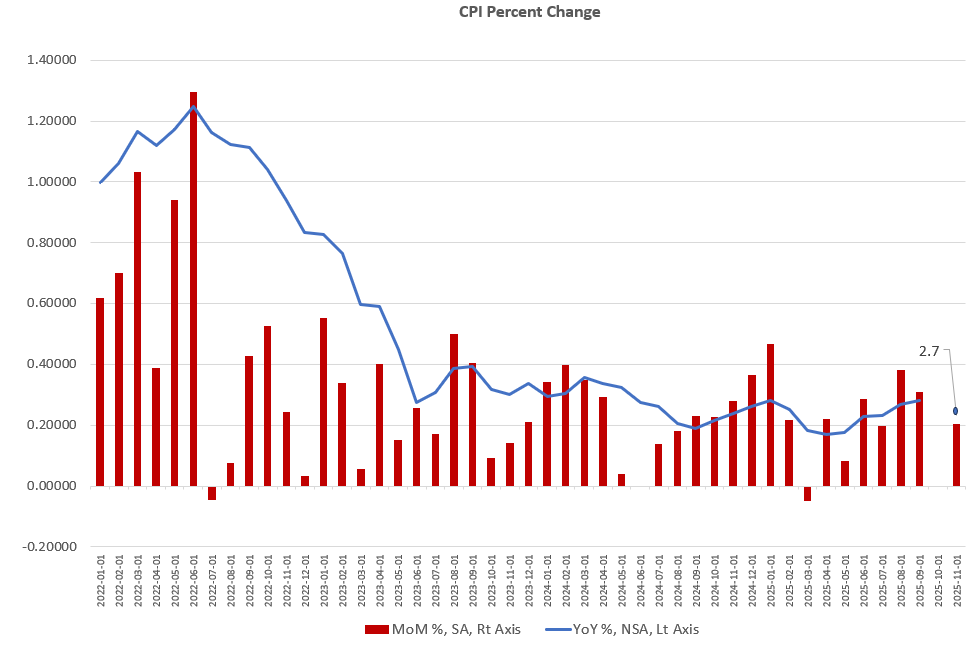
After a long delay, the federal Bureau of Labor Statistics today reported its price inflation report for the first time since the September report. According to the report, price inflation, as measured by the CPI slowed in November, both year over year, and from September to November. (Most October CPI data was not collected due to the federal shutdown.) 

Measured year over year, CPI inflation in November was up by 2.7 percent, falling from September’s YoY increase of 3.0 percent. During the same period, the CPI rose by 0.20 percent from September to November. By comparison, the CPI rose by 0.31 percent from August to September. 

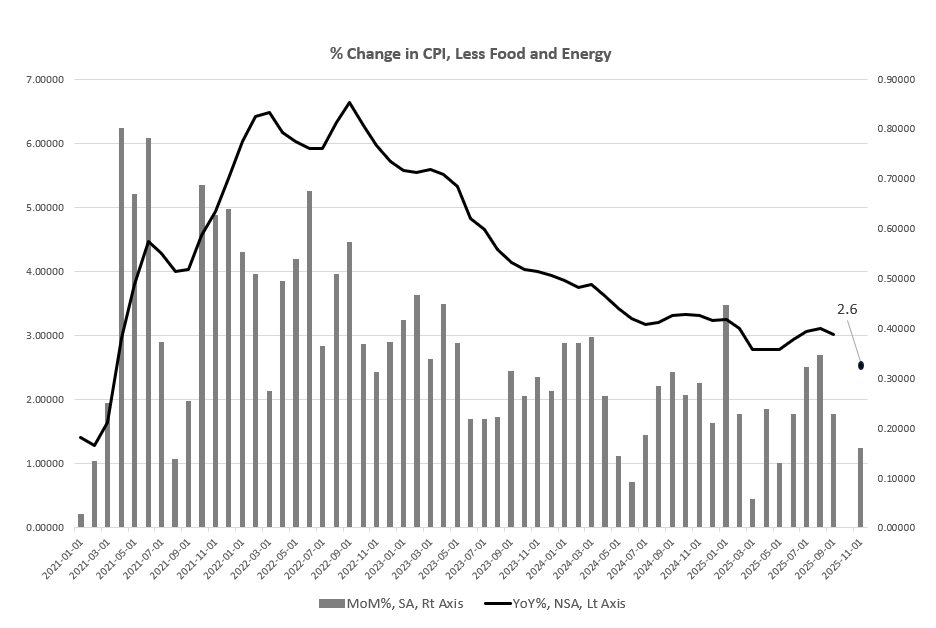
Removing volatile food and energy prices, the so-called core CPI showed similar changes. Year over year, the core CPI also slowed to 2.6 percent in November, falling from September’s YoY increase of 3.0 percent. Core CPI growth also slowed, growing by 0.16 percent from September to November, as compared to 0.23 percent growth from August to September. 


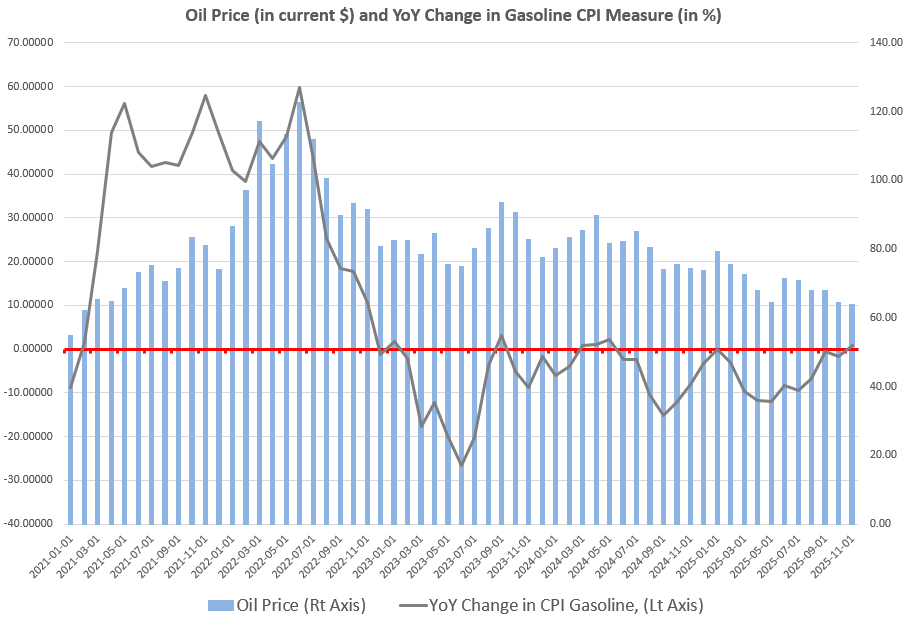
This downward movement in CPI growth—which remains positive and well above the Fed’s two-percent target—reflects, in part, falling oil prices which has helped to drive down gasoline prices as measured in the report. Year over year, the CPI index for gasoline has been down ten of the last 12 months, for example. And the oil price has fallen by more than twelve dollars per barrel over the past year. 


Another factor has been a slowdown in rents in recent months. For example, the CPI for rent was up by 4.3 percent, year over year, during November of last year. This past November, rent growth had slowed to 2.95 percent. We can expect further downward pressure in rents and home prices—which will eventually also slow CPI growth—as BLS data catches up with current and ongoing downward movement in both rents and home prices. 

For example, the National Association of Realtors showed a negative year-over-year change in median listing price for November. For the 12-month period ending in August, eight out of twelve months showed negative growth in prices for new houses sold

This all reflects a general softening of demand as the global economy slows. As Jerome Powell noted at the most recent FOMC press conference, the labor market has slowed significantly in the United States, and new hires have virtually disappeared from the economy—the “job finding rate” has fallen to very low levels. Moreover, layoffs in October and November rose to levels not seen since 2009

This helps explain, in part, why the Fed has continued to loosen monetary policy even as CPI inflation has failed to move back to the Fed’s two-percent target over the past year. Remember, for example, that it was back in September of last year when Powell claimed CPI inflation was moving swiftly back toward two percent. At the time, Powell was justifying the Fed’s cut to the target interest rate even as CPI inflation remained near 3 percent. (The cut was clearly politically motivated, but Powell had tom come up with some sort of excuse for the move.)

Powell and the Fed were clearly wrong, given that 14 months later, the CPI inflation rate is still closer to 3 percent than two percent. (The Fed’s preferred inflation measure, PCE, was still 2.8 percent in the most recent report, and the latest Cleveland Fed estimate still shows 2.61 percent.)

Yet, the Fed likely believes it can get away with lowering interest rates during a period of elevated inflation because the slackening economy will put downward pressure on demand, and therefore on prices. We’re already seeing it in oil prices and real estate prices. Economic weakness is also seen in rising delinquency rates, mounting bankruptcies, and similar measures. 

This will mean falling prices in spite of continued monetary inflation. In other words, as we see price inflation growth flatten, it will be due to larger economic softening, and not to imagine Fed efforts to return to “price stability.” 

Unfortunately, all this means ordinary people will have no chance of regaining any of the lost purchasing power—especially purchasing power lost due to supercharged price inflation that occurred during 2022 and 2023. The Fed will not allow prices to fall, no matter how much demand falls. That is, were the Fed to back off on its efforts to further fuel additional monetary inflation, price deflation would provide relief to consumers via falling prices. That won’t happen because the benefits of deflation will instead be nullified by continual monetary inflation from the Fed. As workers are forced to scrimp and cut back due to stagnation in employment and real wages, workers will still have to face rising prices. Powell, after all, admitted during December FOMC press conference that “conditions in the labor market appear to be gradually cooling, and inflation remains somewhat elevated.” This is also called stagflation. We can already guess what “solution” to the problem the Fed will choose. The answer is always “more monetary inflation.” 

Originally published by the Mises Institute. 

Wednesday, December 17, 2025

November’s Weak Jobs Report Pushes the Fed Toward More Monetary Stimulus

Originally published by the Mises Insitute.

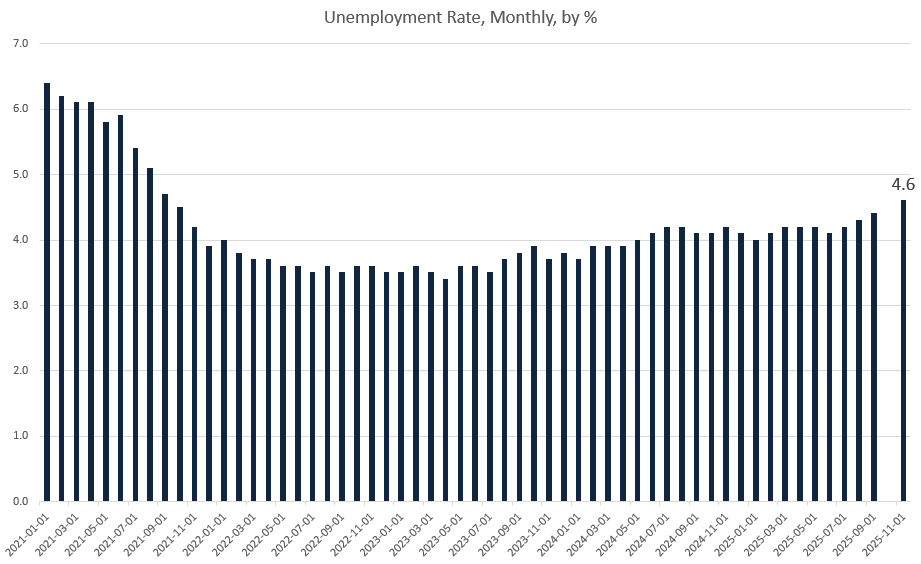
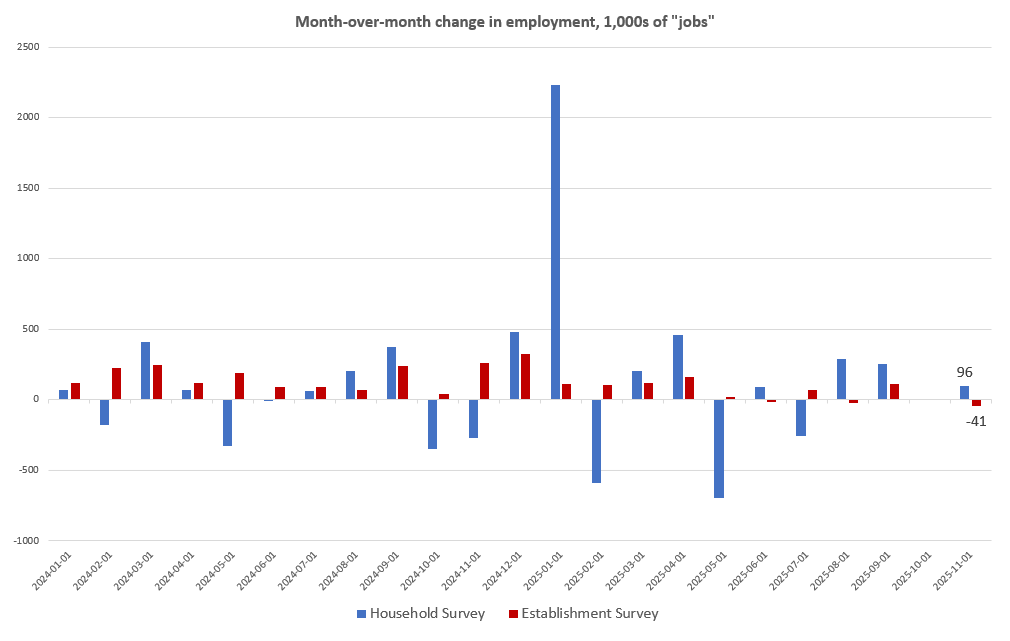
 The Bureau of Labor Statistics finally released its November report today—after a nearly ten-day delay—and the latest data shows that the employment situation in America continues to slowly worsen. During November, the unemployment rate increased to a fifty-month high of 4.6 percent even though total payrolls rose by 64,000 from October to November. Overall, November’s report showed lackluster payroll growth fueled by rising numbers in part time employment. 

Although the BLS is apparently back on track with its November report, following the partial federal shutdown, some key sections of the October report—especially from the household survey—have not been calculated or published. So, month-to-month comparisons are difficult for the October-November period. Instead, much of what I look at here will be comparisons between September and November, to allow for comparisons between the establishment survey and the payroll survey. 

From September to November, establishment-survey employment decreased by 41,000 jobs, although total employed persons, measured via the household survey, rose by 96,000. (November totals below are the two-month change from September to November):

Since April 2029, though, neither household employment nor payrolls have changed much. For example, in April, the BLS reported total household employment at 163.9 million persons. In November, the total was only 163.7 million. Similarly, for total establishment-survey jobs, the total in April was 159.4 million jobs. The total in November had risen to only 159.5 million, rising only 119,000 jobs in seven months. 

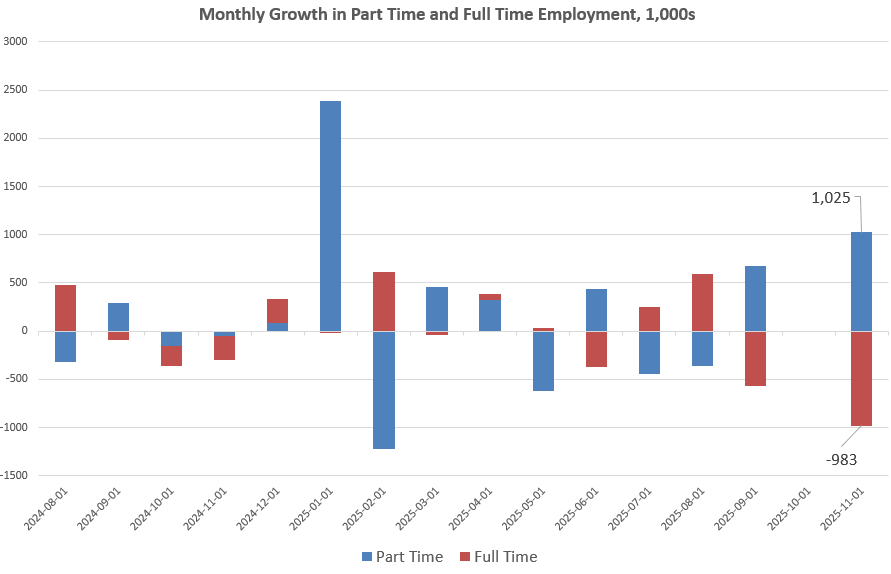
Meanwhile, the household survey in November showed a surge in part-time employment, suggesting that the jobs gains we do see are largely due to part time employment. For example, from September to November, full time employment fell by 983,000. That’s one of the largest drops we’ve ever seen outside a recession. Moreover, the total number of part-time positions surged by 1.03 million, one of the biggest gains recorded. (November totals below are the two-month change from September to November):

The total number of workers taking on part time work for economic reasons rose to the highest level since 2021, surging to 5.5 million workers. 

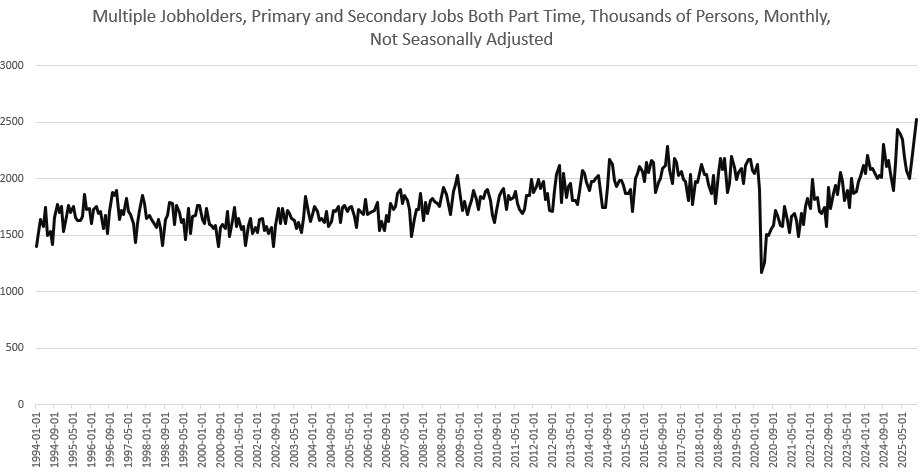
Moreover, the total number of multiple jobholders (with primary and secondary jobs being both part time) rose to the highest level recorded in more than thirty years, rising to 2.5 million workers. 

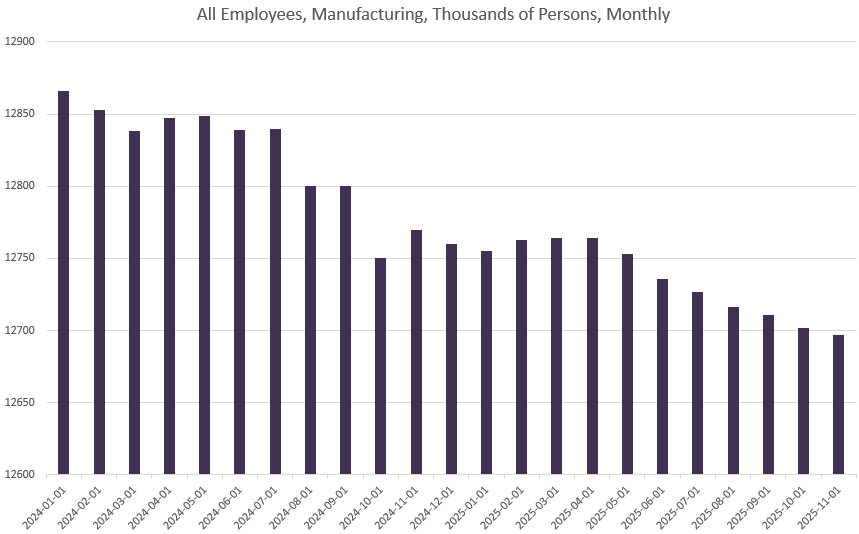
The total number of manufacturing jobs has now fallen for seven months in a row:

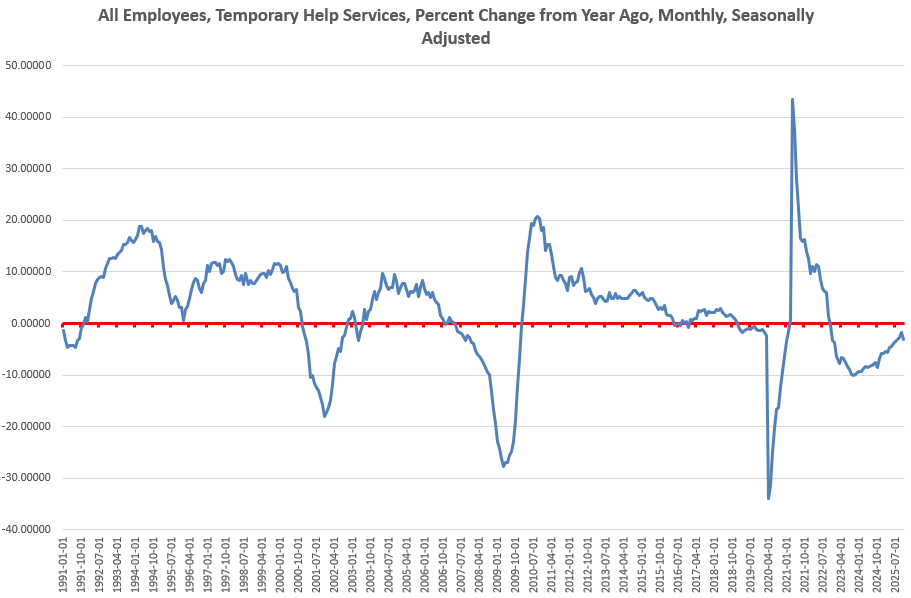
Meanwhile, temporary jobs moved deeper into negative territory (measured year over year.) This measure, when negative for three or more months in a row, has always coincided with a recession over the past 35 years.

One might say that the only real bright spot in this jobs report was the month-to-month increase in payroll employment. Yet, the report of the payroll gain from October to November comes out mere days after Fed Chairman Jerome Powell, at the December FOMC press conference, cautioned the public against putting much stock in the reported payrolls totals. According to Powell, employment is “cooling” even faster than the reported headline data in recent months suggests: 

Unemployment is now up 3/10 from June through September. Payroll jobs averaging 40,000 per month since April. We think there’s an overstatement in these numbers by about 60,000. So that would be negative 20,000 per month. And, also, just to point out one other thing, surveys of households and businesses both showed declining supply and demand for workers, so I think you can say that the labor market has continued to cool gradually, maybe just a touch more gradually than we thought.

Naturally, it’s unclear if November’s count will require sizable revisions as have total job counts in other recent months, but as Powell noted, overall initial counts have been overly optimistic for months. 

These disappointing jobs numbers are also reflected in private-sector employment statistics which have been the subject of more attention in recent months thanks to the federal shutdown. For example, the November report from ADP showed a 32,000 drop in private sector employment for the month. The situation for small employers was even worse, and the overall drop in the private sector was driven by falling employment in firms with fewer than 50 workers. Small businesses are more immediately sensitive to changes in economic conditions, and this may be a leading indicator of where the job market is heading. 

The Rovelio Labs report on total employment, which includes government employment, showed an overall drop of 9,000 jobs in November, which according to the report authors was “predominantly driven by employment losses in the retail trade and manufacturing sectors.”

Although the Fed lacked employment data for October and November during its most recent FOMC policy meeting, the Fed was likely pushing its new policies while assuming more soft employment data. The latest data from the BLS further helps the Fed, politically speaking, in its efforts to justify further cuts to the target policy interest rate even though price inflation measures remain near three percent, and are not—as the Fed has repeatedly insisted—hurrying back to the stated two-percent inflation target. 

Rather, it appears now that the Fed is still trying to engineer a “soft landing” with repeated cuts to the target policy rate, and rely on a softening of economic conditions to keep price inflation from spiraling back to 40-year highs like we saw in 2022. This might have already occurred were economic conditions more robust right now. 

With such weak employment growth, however, weakening demand from workers puts downward pressure on prices, and gives the appearance that the Fed’s monetary policy is bringing price inflation under control. 

Signs of increasingly weak demand are found in several places, although not in retail sales which continue to benefit from high-income spenders and from the continued use of consumer credit, including buy-now-pay-later services. For example, BNPL services have surged in recent years with the rise of apps like Afterpay and Klarna. This has helped prop up retail sales, and a November study from the Harvard Business Review states

We found that BNPL adoption led to immediate and substantial increases in spending. Consumers who adopted BNPL were more likely to purchase, with purchase likelihood increasing from 17% to 26%. Furthermore, when adopting consumers made purchases, their basket sizes were 10% larger on average than they were before the introduction of BNPL. Remarkably, these increases in spending were not short-lived: They persisted for close to six months, showing that BNPL drives lasting gains rather than short-term spikes in consumer spending.

Who is most affected? Our analysis suggests that the impact of BNPL is greater for “financially constrained shoppers.” 

BNPL is a substantial portion of overall spending. Although retailers reported record spending on the Black Friday-Cyber Monday period this year, over nine percent of that spending was financed by BNPL. 

Consumers who use BNPL, however, tend to miss payments more often than consumers who use more traditional funds for consumer spending. This reflects an overall worsening in the credit situation which can been seen in rising delinquencies for credit cards and auto loans, especially among lower income consumers. 

Other indicators that point to bad news for the job market include bankruptcies at a 15 year high, foreclosures up for the ninth straight month, and initial unemployment claims rising in early December by the largest total since 2021

Demand will weaken as these trends continue, putting further downward pressure on price inflation. However, those workers who experience falling wages, or who become unemployed, will be unable to take advantage of deflation. Even though workers in a recession badly need deflation to regain some purchasing power for their increasingly scarce income, the central bank will intervene with easy money  to keep price inflation positive in the name of “stimulus.” Politically, the Fed will use stagnation-induced deflation as political cover for the Fed to return to aggressive quantitative easing and even lower target interest rates. If employment reports continue to show growing economic stagnation, calls for more monetary inflation and government spending will only grow.

Saturday, February 1, 2020

Rent growth has slowed in Colorado Springs over the past two years

For the first time in years, I updated the Colorado Springs vacancy and rent graphs.

First, let's look at the vacancy rate for the region.  During the third quarter of 2019,  the Colorado Springs vacancy rate fell to 5.0 percent. That's down from 5.4 percent during the second quarter, and it was down from 5.2 percent as recorded during the third quarter of 2018, one year earlier.

2019's third quarter rate was the lowest vacancy rate recorded since the third quarter of 2016, when the rate was 4.0 percent.

This suggests vacancies are in a downward trend at the moment, but there rate isn't exactly at historical lows. Five percent suggests mostly full units, but I wouldn't describe it as an especially "tight" market.


Not surprisingly, though, this decline in vacancy in the last two years has come with rent growth — but not a lot of rent growth.

From the third quarter of 2017 to the third quarter of 2019, the average rent grew 8.6 percent (or 98 dollars) from $1,113 to $1,231.


This is an average, so is skewed upward by new construction. As noted in October in the Gazette:

Most Colorado Springs-area apartment projects built in recent years have been upscale, amenity-filled communities that command top dollar for rents, said Laura Nelson, the Apartment Association’s executive director.

“The only supply we’re adding is high end,” she said. “So when you add high-end units, then it pulls your average up. That doesn’t necessarily mean than everything is going up that high. But when that’s all that you’re adding in, it throws off the average.”

Though several apartment projects have been built in recent years, the overall supply might not be keeping up with demand.

In the third quarter, only about 2,600 of the area’s supply of 51,142 apartments were available for rent — a 5 percent vacancy rate that was the lowest in three years, the Housing Division and Apartment Association report shows.

Nearly 750 units have been added to the area’s supply in the first three quarters of the year, which is about the same number as during the same period in 2018, according to the report. Even so, an additional 1,178 apartments have been occupied since the start of the year.

If we looked at growth in median rent, the increased would like be smaller, since median numbers are less skewed by new product. I don't have the median numbers yet for the third quarter, but the growth in median rent from the third quarter of 2017 to the second quarter of 2019 actually went down by 10.9 percent. This may have been driven by declines in rents in older and less desirable units.

Year-over-year growth in average rent has slowed over the past two years compared to 2016-2017 when YOY growth frequently topped ten percent.


Friday, January 31, 2020

New Mesa County Foreclosures Hit 12-Year Low in December

Last time, we saw that "releases of deeds of trust" spiked in Mesa County. That suggests some strong demand for for-sale housing in the GJ metro area.

So, not surprisingly, we also find that foreclosures in the area fell to a 12-year low in the area. In fact, these numbers may be lower than anything we've seen in much more than 12 years, but I only have data going back to 2008. In other words, there were fewer new foreclosures in December 2019 than in any other month during which I collected this data.

Specifically,  during December, there were 11 notices of election and demand.  The "NED filing" is the first step in the foreclosure process. That's down from 17 in November 2011, and it's down from December 2018 when 19 NEDs were filed. As the blue line shows below, the NED filings total is even down from where it was in 2008.

The other measure of foreclosure activity "auction sales" has not dropped off quite as much. The "sale" step of the process is the end of the foreclosure process when the property is auctioned off to a new owner.

During December, a total of five properties were foreclosed and sold at auction. That's a low number, but not the lowest we've seen over the past 12 years. Sales totals have been largely flat over the past year, and have returned to what we saw back in early 2008.  Nonetheless, foreclosure auction sales can be said to be at historic lows.

This follows a general statewide trend. Most Colorado counties have seen big decreases in foreclosure activity with combined statewide totals also dipping near 12-year lows.

Moreover, keep in mind the population of both Mesa County and the state have increased over the past decade, so on a per capita basis, foreclosure activity has fallen well below where they were before 2008.

Releases of deeds of trust surge in Mesa County

A release of a deed of trust is an event that occurs when a deed of trust (often referred to as  a mortgage) is paid off, either through refinance, sale, or when all payments have been completed on a home loan. It is a "positive" economic indicator in sense that areas with improving economies tend to generally also report increases in releases of deeds of trust.

Other factors can be important as well. In cases where there is a housing shortage, but other economic indicators are robust, we might also see declining release activity. It's not always easy to know which factors are the key factors in whether or not releases are going up or down. 

We do know, though, that releases tend to go up when interest rates fall. And releases tend to go down when interest rates rise. We've seen this in the combined release data for the state's biggest countries.

Combining the state's big metro counties (plus Broomfield County) we saw that releases headed down in late 2018 as the Federal Reserve began to allow the fed funds rate to rise. The mortgage rate then followed suit, and releases trended downward. During 2019, however, the Fed began to push rates down again, and releases rose again at the same time:


So far, I only have the data for the combined metros through October. 

An odd thing happened in Mesa County during December, though. According to the Mesa County public trustee's latest data, releases spiked to the highest level I've seen since I began keeping track of releases back in 2008. 

Releases have generally been hovering between 600 and 800 per month in the county over the past two years. But in December, the total shot up to 1,253. That's a huge increase. For instance, in December 2018, the total number of releases was 569:


Based on what I have so far for the other metro counties, many counties are experiencing sizable increases — but this increases appears to be significantly larger than the other counties.  I spoke with the Mesa County PT and confirmed this is correct data, and it is not due to an administrative backlog or an artifact of processing. It does appear to be a result of real events in the local economy. It appears many homeowners in Grand Junction had the opportunity to refinance in December, and many took it. 

We'll know more at the end of January if this is a trend, or if just a quick spike that will soon return to normal. But in either case, the surge in releases suggest confidence in the local housing market on the part of lenders and investors in the secondary market. It may also suggest lenders anticipate the Fed will continue to take a dovish view on inflation and interest rates.

Thursday, August 1, 2019

Colorado Gets More than Half of Its Revenue from Income Tax

Pew breaks it down. I was surprised by how little revenue is generated from severance taxes. And, of course, there is no statewide property tax thanks to TABOR.


Monday, May 21, 2018

In March, 'release of deeds of trust' down 23 percent

A release of a deed of trust is an event that occurs when a deed of trust (often referred to as  a mortgage) is paid off, either through refinance, sale, or when all payments have been completed on a home loan. It is a "positive" economic indicator in sense that areas with improving economies tend to generally also report increases in releases of deeds of trust.

Other factors can be important as well. In cases where there is a housing shortage, but other economic indicators are robust, we might also see declining release activity. It's not always easy to know which factors are the key factors in whether or not releases are going up or down. 

Since early 2017, the general trend in release activity has been downward. In March 2018, releases totaled 21,304. That's up 11 percent from February 2018, when releases totaled 19,095. Overall, however, monthly data shows that monthly release totals have fallen repeatedly since December 2016's peak of 33,943:


Looking at annual totals, we find that 2017's total was down from 302,249, dropping to 297,151. That's still above 2015's total, however, and well above 2014's totals. 


The trend in year-over-year changes has also shown a decline. Over the past nine months, releases have been down every month, when compared to the same month a year earlier. In March 2018, releases were down 23 percent, compared to March of 2017 — when releases totaled 27,798. 


Another factor at work may be rising interest rates. Since re-finance activity is a factor in releases, and since re-fi's often slow as rates increase, we may be seeing slowing release activity as a result of significant increases in  mortgage rates over the past year. Mortgage rates are now the highest they've been since 2013:


For more on historical release activity in Colorado, see here. 


Saturday, May 19, 2018

Foreclosures in Colorado's Metro Counties Remain Near Multi-Year Lows


Foreclosure activity in Colorado metropolitan counties continues to be near multi-year lows. Over the past two years, foreclosure rates have been exceptionally low compared to the previous decade. 


March 2018 foreclosure filings were down 20 percent from March 2017, dropping from 540 to 432, year over year.

March 2018 foreclosure sales (completed foreclosures) were down compared to March 2017 with a decrease of 33.9 percent, dropping from 177 to 117, year over year.  

Filings rose 6.1 percent from February 2018 to March 2018, and auction sales were up 19.4 percent over the same period.

For the first three months of 2018 as a whole, foreclosure filings were down 11.8 percent, compared to the same period of last year. Filings fell from 1,429 for the first three months of 2017 to 1,260 during the same period of 2018. Foreclosure sales were also down during the same period: sales fell 24.9 percent from 450 to 338.

Pueblo County reported the highest foreclosure rate during March, while Boulder County reported the lowest rate. 

Comparing the first three months of this year to the first three months of last year, both filings and sales were down: 

Filings for Jan-Mar:

Sales for Jan-Mar: 

There's not a whole lot to say here except that foreclosure rates are low, and currently show no signs of heading back upward. So long as home prices continue to climb quickly upward, even those homeowners who have troubles with income can always just sell their homes in order to avoid foreclosure. 


Monday, May 14, 2018

Housing: High Prices, Few New Units

During the housing bubble that ended in 2007-8, the amount of new housing construction was remarkable. Enormous subdivisions were being constructed in metro areas across the land. Buildings of condominiums sprang up in city centers, and the ready availability of credit meant many were buying more than one house as "investments" or summer homes. New housing, it seemed, was everywhere. 
At the same time, home prices were increasing, driven up in part by fact that everyone was convinced that housing prices always go up, and real estate — any real estate — was a rock solid investment. 
When the bubble popped, there was suddenly a housing glut. From Las Vegas to Florida, we heard about buildings of condos that were more than half empty, and about suburban housing developments that became ghost towns. 
On the most superficial level, the current boom might remind some of the pre-2008 bubble. Housing prices are climbing fast, and in many areas, there are bidding wars for houses that are quite ordinary. 
This time, though, things are different. This time, there isn't nearly as much housing being built was during the last bubble. There may be a bubble in prices this time, but there does not appear to be a bubble in construction. 
A look at housing starts in recent years shows that in raw numbers, starts are still not even close to getting back to where they were during the last boom: 

Now, some might think "it's good we not going back to bubble levels." True enough. But when we take into account growth in new households, we see that current construction trends are even weaker than the graph above suggests, and are below even more commonly-seen non-bubble levels of construction. 
As both the Wall Street Journal and USA Today noticed last month, the amount of new housing construction taking place right now, as a proportion of existing households, is at historic lows. USA Today reports:
Since the real estate market crash took the wind out of the construction boom of the 2000s, fewer homes are being built per U.S. household than at nearly any time in history.
And the Wall Street Journal concludes:
Home construction per household a decade after the bust remains near the lowest level in 60 years of record-keeping...What makes the slump puzzling is that by most other measures, the American economy is booming. Jobs are plentiful, wages are on the rise and the stock market is near record highs. Millennials, the largest generation since the baby boomers, are aging into home ownership.
When we look at new housing construction compared to total households going back to 1959, we find that 2009 and 2010 were years with the smallest amount of new construction in decadesUnknown Object:

Only the early 90s are comparable to what happened in the wake of the 2008 financial crisis. 
Moreover, since 2010, new construction has rebounded remarkably little. 
Last year, the Kansas City Fed produced a similar analysis, and the results were pretty much the same: new housing construction, taking household growth into account, now remains near a multi-decade low. 
But why has this happened? The Fed Report considers a number of options, including:
One reason is that builders in many metropolitan areas are facing a shortage of qualified construction workers. In addition, smaller builders, which account for the majority of single-family development in some mid-sized metropolitan areas, are having trouble financing land purchases and construction....A third explanation is the limited availability of undeveloped land in desired locations. 
Some of these factors were due to accidents of history. Many of the Mexican immigrants who worked in construction in the US in the decade following the 1994 Mexican financial crisis now are less interested in working in the US thanks to improvements in the Mexican economy. Since 2009, net migration from Mexico has fallen below zero. Some of those leaving took their homebuilding skills with them. 
Meanwhile, finding inexpensive financing for land acquisition and construction has been difficult as money has been siphoned off to other forms of bubble investment as central-bank produced asset inflation continues. 
While real estate is certainly affected by expansive monetary policy, bubbles inflate in unpredictable ways. During the last bubble, investors grew enamored with housing, and money flowed accordingly. But nowadays, as Brendan Brown has often noted, other investment "narratives" have directed many investors' attention elsewhere. It's no longer assumed that housing prices will always go up. Meanwhile, lumber costs, labor costs, and regulatory costs at the local level continue to push up production costs. Since the advent of Dodd-Frank, small banks have been more often squeezed out by a handful of huge banks. As small banks disappear, so does access to financing for many smaller builders in smaller markets. 
Taking all of these things together, the supply of housing is not recovering to more historically normal levels. 
This doesn't mean demand for housing has gone away, of course. Population growth has not contracted like housing construction has. Vacancy rates are down and housing prices in both rental housing and in single-family housing continues to head upward.
And this lackluster production is all happening during a period of expansion. Presumably, it should be easy to find financing to build housing right now, and to find buyers who can pay a price that will cover expenses for homebuilders. That doesn't seem to be happening.